Meine Electric Secures Utility Pilot, Eyes 2027 Deployment
India
October 12, 2026
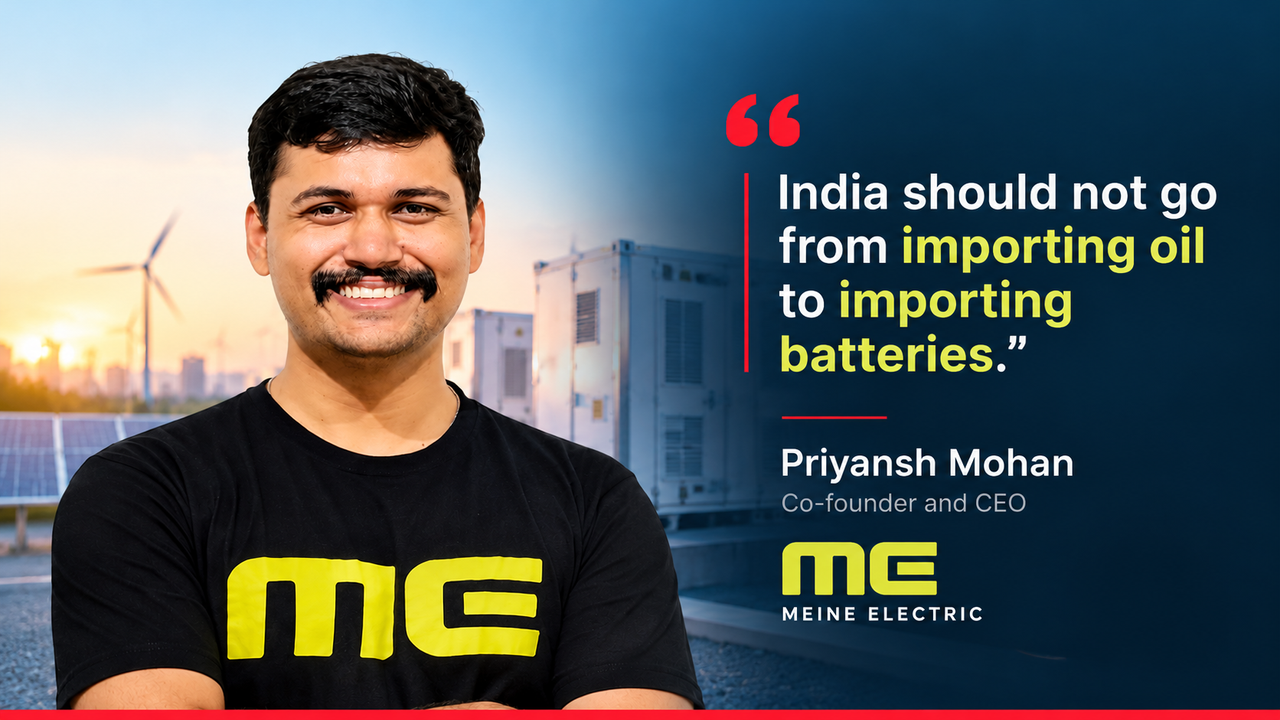
Chennai-based deep-tech startup Meine Electric has recently received independent cell-level validation from Customized Energy Solutions (CES) for its Fast Charge Long Discharge (FCLD) iron-air battery technology, designed to charge in six hours and discharge over 18 hours. But the more crucial development lies in what comes next. Meine Electric has signed a pilot agreement with a major Indian power producer, with deployment targeted for April or May 2027. The company has also signed memorandums of understanding (MoUs) representing several hundred megawatt-hours (MWh) of potential demand with solar and thermal power producers. These developments indicate growing commercial interest, although the technology has yet to demonstrate its performance at commercial scale. In an exclusive interview with CIOL, Priyansh Mohan, Co-founder and CEO, Meine Electric, discussed why the next 9 to 12 months will be critical for manufacturing, what is slowing long-duration energy storage adoption in India, and why the country must develop its own battery technologies rather than exchange dependence on imported oil for dependence on imported batteries. He also outlined the company's longer-term ambition to move beyond battery manufacturing into developing and operating energy infrastructure. What has the independent validation proven, and what challenges remain before commercial deployment? The validation was an essential benchmark for us because it demonstrates that the technology works beyond our internal laboratory testing. It gives external stakeholders confidence that the chemistry and the cell can deliver the intended performance. However, this validation happened at the cell level. It does not establish that the technology works at commercial scale. The next step is to develop battery modules, validate complete systems, and obtain the required certifications. We are also preparing pilot deployments that will take the technology closer to commercialization. For us, the next 12 months are about minimizing production risk. Many processes that work in a laboratory do not necessarily scale into manufacturing. We expect it will take another 9 to 12 months to demonstrate production viability. Once we establish that, the next major challenge will be commercial scale, securing larger orders, delivering systems, and ensuring they perform reliablty. Was your focus on daily energy storage driven by technology or India's renewable energy needs? It was a combination of both. When we studied renewable energy markets, we realized that the requirements of the Global South are different from those of many developed economies. In solar-heavy markets such as India, electricity generation is concentrated within a six-to-eight-hour window. The imbalance between generation and demand occurs every day. These markets need batteries that can charge during the day and discharge over the remaining hours. In regions where wind power plays a larger role, storage requirements can be different, and multi-day storage may be more relevant. We saw an opportunity to retain the advantages of iron-air batteries, including their potential for lower costs, long-duration discharge, and domestic supply chain development, while adapting them to daily solar cycles. Our objective was not simply to develop an iron-air battery in India. We wanted to build a technology suited to the needs of solar-heavy markets across the Global South. Will iron-air batteries compete with lithium-ion, or will both technologies complement each other? I believe different battery technologies will complement each other because energy storage requirements vary by duration. Today, lithium-ion batteries dominate shorter-duration storage, typically between two and six hours. Sodium-ion batteries could also become important in this segment. For medium-duration storage, between six and 12 hours, technologies such as pumped hydro and flow batteries have a role to play. But beyond 12 hours, there is no clearly established technology that dominates the market. That is where Meine Electric wants to compete. We believe long-duration storage will be among the fastest-growing segments as renewable energy penetration increases. Based on our assessment, storage systems operating between 12 and 24 hours could eventually account for approximately 35% to 40% of the market by storage duration. Future power grids will need different storage technologies working together. We are not trying to replace every battery chemistry. We want to build a strong position in the long-duration segment, particularly for daily renewable energy balancing. What is the biggest barrier to scaling long-duration energy storage in India? I would identify two major challenges: customer patience and capital. When you introduce a new technology, customers often want to know whether it can be deployed immediately. But deep-tech development takes time. You need to validate the chemistry, establish manufacturing processes, demonstrate performance, and then move toward commercial deployment. The second challenge is access to patient capital. India has developed a strong startup ecosystem, particularly in consumer-facing businesses. Deep tech is still relatively new from an investment perspective, and investors need to become comfortable with longer development cycles. We are seeing encouraging developments, including government initiatives and investment funds showing greater interest in deep technology. But companies developing infrastructure technologies need investors who understand that commercialization cannot happen overnight. For us, the approach is to engage with customers, investors, and government stakeholders early. If we can address their concerns during development, scaling the technology later becomes easier. How close are you to real-world utility deployments, and what has changed since the validation? We have already signed a pilot agreement with one of India's largest power producers. I cannot disclose the company's name or the exact project details at this stage because they remain confidential. The pilot is expected to become operational by April or May 2027. Apart from that, we have signed MoUs representing several hundred megawatt-hours of potential demand with some of India's major solar and thermal power producers. Customer interest is there. The bottleneck now is largely on our side because we need to scale manufacturing processes, raise funds, and prepare for deployment. There are several moving parts involved in bringing a new battery technology to market. We expect 2027 and 2028 to be important years for demonstrating the technology and building commercial traction. What will determine the success of your first pilot: technical performance, cost, or customer adoption? Technical performance will be the most important factor. One of the toughest challenges in the battery industry is taking a technology out of the laboratory and ensuring it works reliably at a customer's site. We will monitor parameters such as battery degradation, round-trip efficiency, and overall operational performance. The economics are generally evaluated earlier because the customer agrees to a project at a particular cost. Once the system is deployed, the real question is whether it performs as expected over time. If the technical results are satisfactory, that creates the foundation for broader customer adoption. The pilot is about demonstrating that the battery can operate reliably under real-world conditions, not simply proving that the chemistry works. Where can India build an independent battery ecosystem, and where does it still depend on foreign technology? India should not move from importing oil to importing batteries. That is something my co-founder Stuti and I strongly believe. Batteries are a critical part of the clean energy transition, and we need to think seriously about building domestic capabilities. India already has experience in battery manufacturing. We developed a lead-acid battery ecosystem with companies that have operated successfully for decades. A battery industry is not built around chemistry alone. There are four important elements: chemistry, manufacturing processes, technical know-how, and materials and supply chains. If a country can control these four elements, it can build a more independent battery ecosystem. Competing directly with established lithium-ion manufacturers on cost would be difficult because they already have a substantial manufacturing advantage. Instead, India should identify emerging technologies and market segments where it can build capabilities from the beginning. That is one reason we are focusing on long-duration iron-air batteries. Our objective is to develop the chemistry, processes, technical expertise, and materials ecosystem domestically rather than becoming dependent on external technology partnerships. For India to build a sustainable battery industry, it needs to develop these capabilities together. Five years from now, do you see Meine Electric as a battery manufacturer or an energy infrastructure company? At our core, we are a battery manufacturer, and that will remain the foundation of the business. But over the next five years, we could move into developing and operating energy infrastructure ourselves. That could include build-own-operate models or energy-as-a-service projects where we deploy our own storage systems. We would also work with engineering, procurement, and construction companies and partners providing services such as grid modeling. The idea is to expand gradually as the company develops its capabilities. We want Meine Electric to become globally recognized for iron-air battery technology, but that requires us to establish ourselves as a reliable manufacturer first. Everything else builds on that foundation. How would moving into energy infrastructure change your partnerships, manufacturing strategy, and global expansion plans? It would fundamentally change our position. If we remain only a battery manufacturer, our business depends primarily on selling batteries. But if we develop the capability to deploy infrastructure through special purpose vehicles or other project structures, we can participate in larger projects. That gives us greater leverage when negotiating partnerships and commercial agreements. Larger projects can create opportunities for further expansion, but we need to establish the business step by step. The first and most difficult step is proving ourselves as a battery manufacturer. Once we achieve that, we can consider larger infrastructure opportunities and build the partnerships needed to support them. Beyond The Lab Meine Electric's next phase will determine whether its iron-air battery technology can move from successful cell-level validation to dependable grid infrastructure. The company's planned 2027 pilot will be an important opportunity to assess real-world performance, particularly battery degradation, efficiency, and reliability across repeated charging and discharging cycles. Its reported MoUs also suggest early interest from power producers, although these agreements do not necessarily translate into confirmed commercial orders. What sets apart the company's approach is its focus on daily renewable energy balancing rather than multi-day backup alone. But the bigger challenge now lies in translating that technical proposition into a product utilities can manufacture, finance, deploy, and operate reliably. For India's energy storage industry, the broader lesson is clear. Developing domestic battery chemistry is only the beginning. Building a competitive battery ecosystem will also require manufacturing expertise, patient investment, reliable supply chains, and customers willing to support emerging technologies. Meine Electric has taken an initial step toward that transition. Its first utility pilot will offer a more meaningful indication of how far the technology can go.