Autonomous Flight Isn't the Problem, Ground Operations Are: AlgoFET
India
October 13, 2026
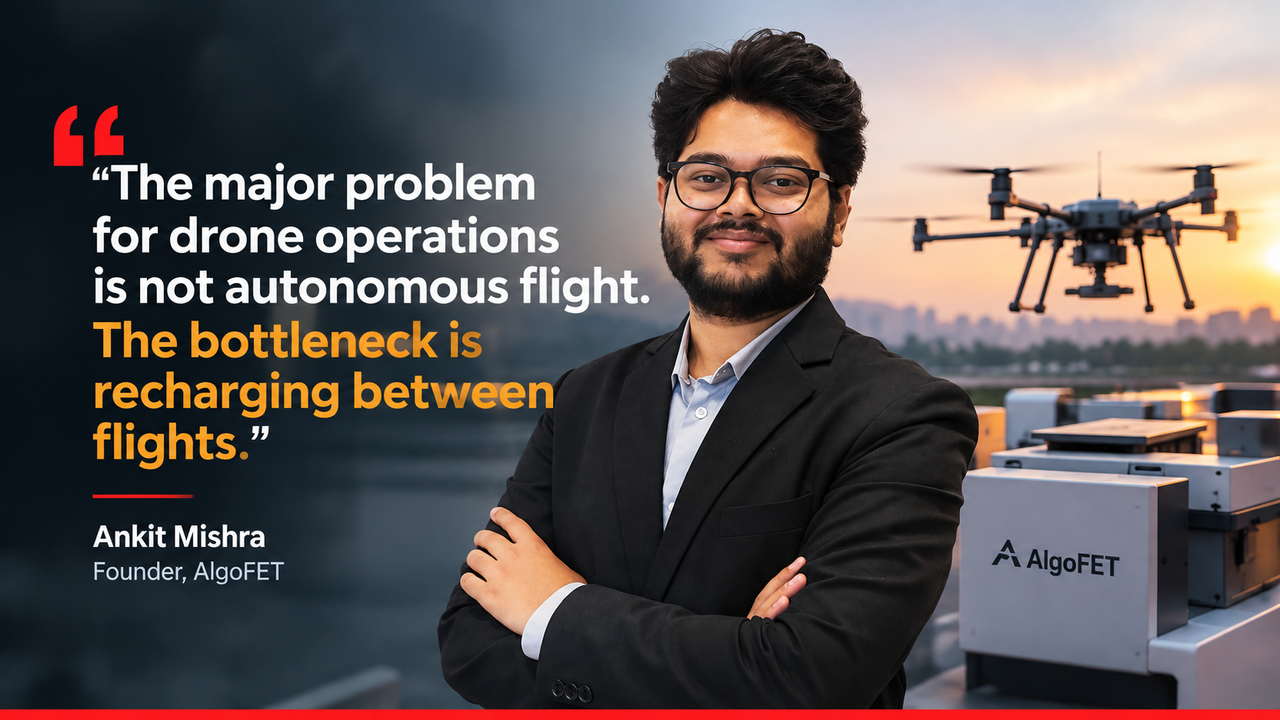
India's drone industry has spent years improving how drones fly. But keeping them operational without people constantly replacing batteries, managing chargers, or preparing them for the next mission remains a challenge. A drone may be capable of flying autonomously, but once it lands, someone often needs to step in. That gap between autonomous flight and autonomous operations is where Bengaluru-based deep-tech startup AlgoFET sees a business opportunity. In an exclusive interaction with CIOL, Ankit Mishra, Founder, AlgoFET, discussed the company's shift from individual charging products to a broader infrastructure platform, the commercial reality behind its ₹100 crore pipeline, and why standardization remains one of the industry's biggest obstacles. He also shared previously undisclosed details about the company's order conversion, revenue expectations, defense exposure, and plans for the next 18 months. What drove AlgoFET's shift from autonomous charging to building a broader drone infrastructure platform? Our original objective was always to make drone operations autonomous. More than five years ago, I started working on this problem at the Indian Institute of Science, Bengaluru. We realized that software could already help a drone navigate autonomously from one point to another. The bigger problem was what happened between flights. Someone still had to remove or replace batteries, ensure they were charged, and prepare the drone for its next mission. That human intervention was limiting continuous operations. Our initial work focused on autonomous charging. We even explored the idea of installing drone docking stations on smart traffic lights so drones could support traffic monitoring and emergency response. But when we started speaking with the industry, we realized that although companies understood the need for autonomous operations, they were not necessarily ready to pay for a complete infrastructure solution. So we divided the problem into different levels. We began by commercializing smart battery management and charging systems because customers already needed those products. They also helped us develop the underlying technologies required for autonomous docking. The long-term objective never changed. We simply changed the sequence in which we developed and commercialized the technology. You have divided drone autonomy into five levels. How does that roadmap work, and how far has AlgoFET progressed? We have structured our development around five levels of operational autonomy. The first level focuses on battery safety, intelligent charging, and reducing human errors. Many operators still lack sufficient information about battery condition and whether a battery is safe for the next flight. We have commercialized smart battery and charging solutions to address that problem. The second level automates charging between flights. Our portable charging pad allows a drone to land and recharge without someone manually handling its battery. This technology is already deployed at Indian Army base camps. The third level involves autonomous docking stations. These systems handle activities such as preflight checks, data collection, and remote monitoring. We have introduced these systems, and initial pilots are underway with defense customers. The fourth level is about making these deployments reliable enough to operate with very little on-site supervision. Our target is to enable one remote operator to manage around 10 systems, with maintenance potentially required only once every quarter. The fifth level is the larger vision. Multiple drones would operate as connected autonomous systems, allowing users to define a mission rather than individually control every drone. We are building toward that level, but it requires the earlier stages to become reliable first. Are you building an open infrastructure platform that different drone manufacturers can use, or will your technology remain tied to specific drone systems? We want to build an open physical AI infrastructure layer that can work across different drone platforms. At the moment, our primary focus is on small-category drones. We also have plans for medium-category systems, and we recently introduced a solution for micro-category drones. Our approach is not to restrict the technology to one drone manufacturer. Indian drone companies are still spending considerable effort improving the reliability of their aircraft. Automating the entire operation introduces another level of complexity. We want to address that complexity through a common infrastructure layer. The idea is that drone manufacturers can focus on building their aircraft while we provide the systems required to manage charging, docking, and autonomous operations. With over 2,000 units deployed, what remains the biggest barrier to continuous drone autonomy, and how far can automated docking and charging address it? One of the biggest challenges is the lack of standardization. Different drones have different battery configurations, charging requirements, and communication protocols. There is no common standard that every manufacturer follows. This makes automation difficult because a docking station must communicate with different aircraft and charging systems. We have seen similar challenges in other industries, including electric vehicles, where charging standards became important as the market developed. In drones, manufacturers are developing their own technologies and intellectual property. That creates different technical requirements across platforms. Our objective is to build infrastructure that can accommodate those differences. For the end user, the experience should be simple. They should not need separate software or hardware controls for every drone. We want to handle those differences at the backend so that operators can manage different systems through a common infrastructure layer. Of AlgoFET’s ₹100 crore pipeline and 4,000-plus units, how much is confirmed business versus customer interest, and when will it convert into revenue? Approximately 25% of that pipeline has already been converted into orders that our team is working to deliver. We are targeting delivery over the next five to six months. For the remaining 75%, we have visibility into the products, expected quantities, and customers. There is significant customer intent, but we still need to convert that demand into actual business. This is one of the areas where the funding from Piper Serica will help us. We need to expand our sales, service, and support capabilities to reach more customers. At present, we serve fewer than 10 drone companies in India, while we estimate there are more than 200 companies that could potentially become customers. We see four areas of growth. The first is scaling our existing products, which we expect to contribute a major part of the ₹100 crore opportunity. The second is expanding into new markets with product variants and certifications suited to different countries. The third is developing new products alongside customers who have already expressed demand. We are planning to launch two additional products by December 2026. The fourth is developing new technologies that may not contribute directly to the current ₹100 crore pipeline but could create future business opportunities. We hope to substantially convert the existing pipeline by the next financial year. The percentages are management estimates from the interview. The converted portion is not necessarily recognized revenue, and the remaining pipeline is not confirmed orders. Defense is an important market, but procurement cycles can be long and customer concentration creates risks. How are you reducing dependence on defense contracts, and what business mix are you targeting? We are addressing this in two ways. First, we sell battery management and charging products to business customers, including companies that eventually supply products to defense organizations. This allows us to work through business-to-business relationships rather than relying entirely on direct defense procurement. For these products alone, we expect business worth more than ₹20 crore this year. Second, for newer products where we believe the application itself needs to be demonstrated, we work more directly with defense customers. At the same time, we are exploring enterprise applications where autonomous drones can support business operations. For the current year, our business mix could be approximately 80% defense and 20% enterprise. Next year, we are targeting at least 30% from enterprise customers. That is the visibility we currently have. I would not want to give a definite projection for the following two years. Beyond defense, where do you see the strongest commercial opportunity for autonomous drone infrastructure? One of the challenges with enterprise adoption is that companies often do not want to operate drones themselves. They want the information or service that drones can provide, but managing aircraft, pilots, charging, and maintenance is outside their core business. That is why many companies currently prefer a service-based model. We believe that if autonomous docking systems become reliable and simple enough, enterprises could deploy drones without building large specialist operating teams. For example, companies could use drones for power line inspections, solar infrastructure monitoring, or other repetitive operations. There is also an opportunity for entrepreneurs who can use autonomous drone systems to solve specific customer problems. Different industries need different types of information. Sometimes the drone hardware can remain the same, while the software and data processing requirements change. Our focus is on making the underlying infrastructure reliable enough for these applications. You are exploring the US and Europe, but drone systems differ across manufacturers and markets. How will AlgoFET handle interoperability and scale internationally? Interoperability is a significant challenge, and we have developed an internal strategy to address it. We have already worked on this problem in India, and we are looking at applying a similar architecture in other markets. There are technical details of that approach that we cannot disclose at the moment. But our objective is to make integration easier for customers, even when their drone platforms and requirements differ. CIOL: Will your international strategy focus on exporting Indian-made hardware, licensing technology, or deploying solutions locally? Ankit Mishra: I cannot comment on that yet. You will see more about our approach in the coming months. Five years from now, do you see AlgoFET primarily as a hardware manufacturer, a software platform for drone operations, or an infrastructure business that customers pay to use? Our primary focus is solving the operational problems that prevent drones from becoming fully autonomous. We believe autonomy can improve the reliability and predictability of drone operations because machines can make certain operational decisions without constant human involvement. We want to play a significant role in solving this problem globally. We are not looking at docking stations as isolated products. We are building the technologies required for autonomous operations from the ground up. That includes the systems needed to manage charging, docking, battery performance, and other operational requirements. We do not believe we need to be the only company working in this space. Our objective is to make a meaningful contribution to the infrastructure that enables autonomous drone operations. If we speak again 18 months from now, what two or three milestones should the industry use to judge whether AlgoFET has built a scalable business rather than simply increasing deployments? The first milestone would be large-scale deployment in defense, where multiple drones can operate continuouslyy and defense personnel can manage the systems themselves. That is important because it is not enough to develop the technology. The people using it must be able to operate it reliably through clear procedures and a simple interface. The second milestone is achieving similar scale in enterprise applications in India. We want to see established companies adopting autonomous drone systems as part of their regular business operations. For us, the next 18 months are about proving that this technology can work at scale in both defense and enterprise environments.