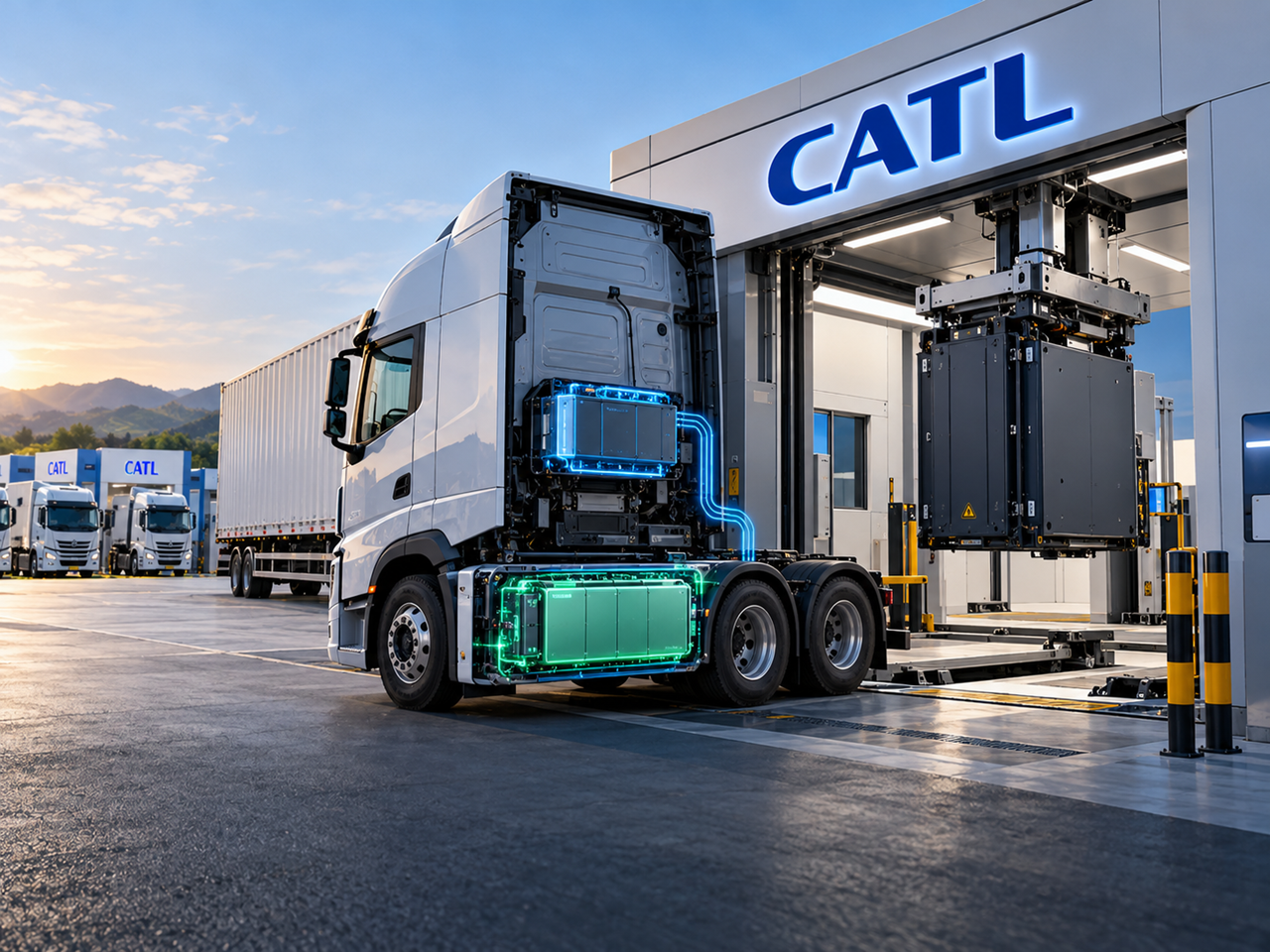
CATL Unveils Dual-Battery System, Plans 900 Truck Battery-Swapping Stations by 2026
India
October 21, 2026
Chinese battery maker CATL has unveiled a dual-battery system for electric heavy-duty trucks and a new generation of battery-swapping solutions, aiming to improve fleet economics and accelerate the electrification of road freight transport. The dual-electric range-extension battery combines a standardised, swappable main battery with a separate backup battery mounted behind the truck’s cab. The system is designed to improve battery utilisation, maintain a continuous power supply and give fleet operators greater flexibility in managing battery costs. The range-extension system currently uses a 77 kWh battery capable of 3C charging. According to CATL, it provides backup power when the main battery’s state of charge falls below 5%, with the system switching power supply within milliseconds. The arrangement is intended to address a limitation of conventional battery-swapping trucks, where drivers may return to swapping stations with unused battery capacity to avoid running low on charge. CATL said the additional battery could increase the main battery’s depth of discharge from around 70% to more than 95%, improving utilisation. The system follows a “1+X” architecture, in which the main battery remains compatible with QIJI’s standardised battery-swapping network, while the range-extension battery can be configured for specific operating conditions. Options include high energy density, low-temperature performance and high power output. CATL said the two battery systems can be upgraded independently. The range-extension battery remains with the vehicle throughout its service life, while the main battery can be leased according to seasonal freight demand. QIJI targets 2,000 swapping stations by 2027 CATL’s battery-swapping business, QIJI Energy, is building an ecosystem around standardised batteries, swapping infrastructure and battery-as-a-service (BaaS) offerings. IJI has introduced two additional standardised battery-swapping blocks: the 260# unit, with a capacity of 432 kWh, and the 300# unit, with a capacity of 513 kWh. These complement its existing 75# block. The company said its system can complete a battery swap in five minutes, with a first-time success rate of 99.99%. Under its BaaS model, customers pay for net energy charged rather than total energy discharged. CATL said this arrangement allows users to retain the value of energy recovered through regenerative braking and can reduce per-kWh battery rental costs by up to 20% for customers on basic plans. QIJI also offers flexible leasing arrangements intended to help fleet operators manage seasonal variations in freight demand and reduce costs when vehicles are idle. CATL plans to deploy 900 battery-swapping stations by the end of 2026 and 2,000 by 2027. Its longer-term target is to establish 10,000 stations nationwide in collaboration with partners. The company said the network would connect major freight corridors and improve access to battery-swapping infrastructure for long-haul electric trucks. Its infrastructure strategy also focuses on reducing vehicle downtime, making more efficient use of station land and matching battery capacity to transport requirements. Partnerships and new battery offerings CATL said agreements covering 13,000 units were signed at the event, although it did not specify in the announcement the delivery schedule or the breakdown of the orders. The company also introduced a range of heavy-duty truck batteries designed for different vehicle configurations and operating requirements. These include rear-mounted ultra-light and ultra-thin batteries for applications where weight and space are critical, as well as chassis-mounted batteries for short-haul and long-haul operations. QIJI is seeking to expand participation across the commercial vehicle value chain through partnerships with truck manufacturers, financial institutions, insurers, dealers and aftermarket service providers. Its partnership models include battery asset service partners and energy replenishment service partners. “The combination of the dual-electric range extension battery and QIJI battery swapping offers the best solution for electrifying heavy-duty trucks,” said Jesse Yang, CEO of QIJI Energy. The announcement reflects CATL’s effort to address not only battery performance but also the operating economics of electric freight. The commercial viability of the approach will depend on the expansion and utilisation of swapping infrastructure, battery leasing costs and adoption by fleet operators.